

Blog
Emerald Jewellery Jaipur: How to Judge a Rare Stone Before You Commission a Piece

Ask a gemstone dealer which stone gives them the most sleepless nights, and most will say Emerald before you finish the question. Emerald Jewellery Jaipur carries a reputation built on genuine scarcity, not marketing. In fine quality, Emerald is rarer than diamond, and it behaves nothing like diamond either — softer, more fragile, more forgiving of imperfection in some ways and utterly unforgiving in others. At Taparia Jewels, we have spent decades learning exactly where that line sits. We craft Kundan, Meena, Jadau, Polki, Diamond & Open Setting jewellery from our C-Scheme workshop, and every Emerald that enters it gets evaluated on colour, origin, and clarity long before anyone sketches a single design.
This guide is the one we wish more buyers read before, not after, they fell in love with a stone.
Why Colour Decides Emerald Jewellery Jaipur Value Before Size Ever Enters the Conversation
Here is something that surprises almost every first-time buyer we meet: a two-carat Emerald with deep, saturated green will comfortably outvalue a four-carat stone with a washed-out, yellowish tone. Weight impresses at a glance. Colour is what actually holds up under scrutiny, and under resale, years later.
We look at three things together, never in isolation — hue, saturation, and tone. Hue tells you whether the green leans bluish or yellowish. Saturation tells you how intense that green actually is. Tone tells you whether the stone sits too dark to show its true colour, or too pale to hold any presence at all. Get all three right together, and you have something genuinely rare. Get even one wrong, and no amount of carat weight rescues the piece.
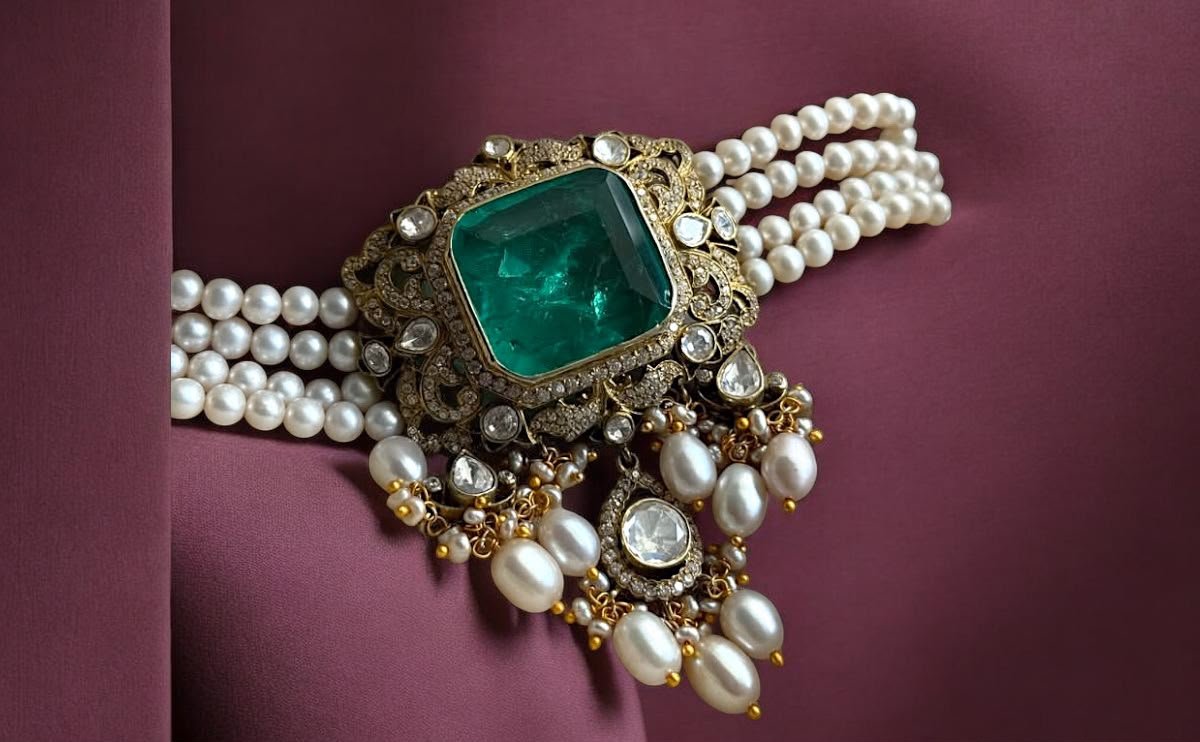
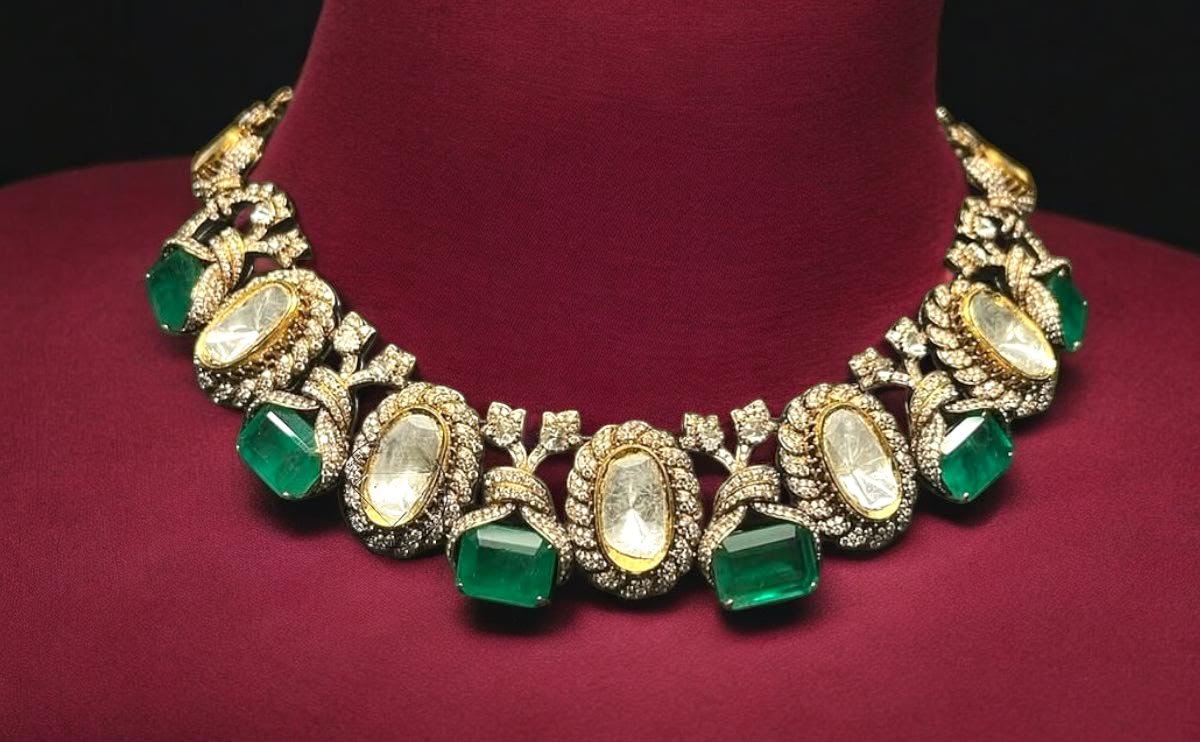
Our emerald Polki choker exists because of this exact discipline — every stone in it earned its place on colour first, everything else second.
Colombian Versus Zambian: Two Very Different Personalities in One Gemstone
Ask ten jewellers which origin is "better," and you'll likely get ten confident, contradictory answers. The honest truth is that Colombian and Zambian Emeralds are simply different characters, not competitors on a single scale.
Colombian stones, mined from deposits that have supplied royal courts and empires for five centuries, carry a warm, slightly bluish-green that collectors have chased since before India had its own jewellery trade with the West. Those historic mines are depleting now, year by year, which is exactly why exceptional Colombian material has become genuinely difficult to source, even for workshops with decades-old supplier relationships like ours.
Zambian Emeralds tell a newer story. Mined largely since the late twentieth century, they typically show a deeper, cooler green with noticeably fewer inclusions than their Colombian cousins — a trade-off between historic romance and practical clarity. Neither wins outright. We match origin to the wearer and the piece, not to whichever name happens to carry more prestige in a given season. Our detailed gemstone sourcing guide walks through exactly how we make that call, stone by stone.
The Garden Inside the Stone: Why Emerald Inclusions Are Not a Flaw
If you learned about diamonds first, Emerald will confuse you at first glance. Diamond grading punishes inclusions ruthlessly. Emerald grading expects them, almost welcomes them — the trade even has a name for the internal world of fractures and mineral traces visible inside most natural stones: the jardin, French for garden.
A truly inclusion-free Emerald is so rare that its very flawlessness should raise your eyebrows, not lower your guard. More often than not, exceptional clarity in Emerald means either extraordinary luck or a lab-grown substitute wearing a natural stone's price tag. We show clients exactly what sits inside every Emerald before it goes anywhere near a setting, because a buyer who understands the garden makes a far better decision than one who was simply told to trust us.
Setting the Stone: Why We Reach for Open Setting Almost Every Time
Emerald wants light to move through it, not bounce off a foil backing hidden underneath. This is precisely why our Open Setting jewellery work has become something of a signature for Emerald commissions specifically. Nothing conceals the stone here. Every angle stays exposed, which means every flaw in the gold work would be exposed too — a discipline that keeps our Karigars honest, piece after piece.
Closed setting still has its place, particularly for older, more traditional designs where a backing genuinely enhances a weaker stone's glow. But for an Emerald that has already earned its colour honestly, hiding it feels almost disrespectful to the work the earth put into making it.
What Happens When Emerald Meets Polki and Diamond in the Same Piece
Some of our most striking commissions pair Emerald's cool green directly against Polki's warm, irregular sparkle. Our guide on what Polki Diamond jewellery actually is, and why Jaipur became its home, explains why that contrast works so well — two entirely different kinds of rarity sitting side by side in the same gold.
Our comprehensive Polki, Emerald and Diamond guide goes deeper still into how we balance the three within a single design, and our Diamond Jewellery Jaipur guide explains what we look for in the certified accent stones that frame an Emerald centrepiece without ever competing with it.
Emerald Alongside Ruby and Tanzanite: A Wider Colour Story
Emerald rarely lives alone in our workshop's imagination. Our Ruby Polki ring collection shows how warmth and coolness can sit in the same client's collection without conflict, each stone chosen for its own occasion rather than forced into a matched set. Our Tanzanite Polki ring collection, drawn from a deposit that exists nowhere else on earth, gives collectors building a genuine gemstone story a third colour entirely.
Clients drawn toward symbolic, multi-stone design often move naturally toward our Navratan jewellery collection too, where Emerald takes its traditional place among nine sacred stones rather than standing alone.
Emerald Across a Full Bridal Wardrobe
A single Emerald piece rarely tells the whole story on a wedding day. We see it woven through entire commissions — our guides to Kundan Meena Jadau jewellery, the Jadau necklace, the Kundan choker necklace, and the maang tikka all explain how a single Emerald tone can carry consistently from the neckline to the hairline.
Smaller Emerald accents show up just as beautifully in our Polki Diamond earrings, Polki Diamond bangles, Polki Diamond pendant, and Polki Diamond brooch collections, each proving that a coordinated colour story doesn't require every piece to be heavy or occasion-only. Our broader guide to bridal jewellery trends for 2026 explains why this kind of considered coordination has become the norm rather than the exception among the brides we work with now.
When Emerald Belongs to the Groom, Too
Emerald has quietly found its way into groom styling over the past couple of seasons, echoed in cufflinks, brooches, and the odd kada detail. Our guide to Groom Jewellery Jaipur covers this shift, and it pairs naturally with a bride's own Emerald choices when a family wants both partners to photograph as one coordinated story rather than two separate ones.
A Piece Built Entirely Around One Exceptional Stone
Every so often, an Emerald arrives at our workshop that simply refuses to share the spotlight with anything else. Our approach to Statement Jewellery Jaipur exists exactly for these moments, and our broader philosophy around High Jewellery Jaipur explains why the world's finest houses have always let the gemstone dictate the design rather than the other way round.
Our current Zambian Emerald Polki & Diamond Choker, available now for private viewing at our workshop, is exactly this kind of piece — built around one stone that earned every bit of attention it commands.
Emerald as an Asset, Not Just an Adornment
Buyers who treat jewellery purely as decoration miss half the picture with Emerald specifically, since fine material has genuinely tightened in supply as historic mines age. Our breakdown of jewellery investment in Jaipur explains why documented origin and honest colour grading matter enormously here, and our approach to Premium Jewellery Jaipur pricing explains why we would rather show you exactly what you're paying for than round the numbers into something friendlier-looking.
Families marking a significant milestone often reach for Emerald specifically for this reason, a point we go into further in our guide to Anniversary Jewellery Jaipur.
Emerald for Custom Commissions and NRI Clients Sourcing From Abroad
Many clients begin a custom Emerald commission with nothing more than a colour in mind, sometimes a memory, sometimes a photograph. Our guide to Custom Bridal Jewellery Jaipur explains how that conversation unfolds, from first sketch to finished piece.
International buyers face a particular version of this challenge — trusting a stone they cannot yet hold. Our guide to NRI Bridal Jewellery Jaipur explains how we conduct these consultations remotely, and visitors planning to view Emeralds in person during a Jaipur trip may also find our Jaipur Jewellery Shopping Guide useful before they arrive. Families timing a purchase around the coming celebration season should also glance at our wedding season and destination wedding guides, since Emerald sourcing genuinely benefits from a head start.
Living With Emerald: Care That Actually Matters
Emerald sits considerably softer than diamond on the hardness scale, and it forgives far less rough handling. Skip ultrasonic cleaners entirely — the vibration can widen existing inclusions rather than remove dirt. Keep it away from sudden heat and household chemicals, both of which stress the stone's internal structure over time. Store it apart from harder gemstones that could scratch its surface during transport or storage.
None of this makes Emerald a difficult stone to own. It simply asks for the same respect you'd give anything genuinely rare.
Booking a Private Viewing
We would rather show you an Emerald in person than describe it over the phone — colour genuinely changes under different light, and photographs rarely capture it honestly. A private appointment at our C-Scheme workshop lets you see current stock directly, ask every question you have, and take your time with a decision that deserves it.
Follow Taparia Jewels for New Emerald Arrivals
Follow us on Instagram at Taparia Jewels for behind-the-scenes sourcing updates. Connect with us on LinkedIn at Taparia Jewels for our full knowledge series. Our complete blog collection covers every technique and gemstone referenced above in far greater depth.
Frequently Asked Questions
Is Zambian or Colombian Emerald the better choice?
Neither wins outright. Colombian stones carry a warmer, historic green; Zambian stones offer a deeper tone with typically higher clarity. The right choice depends on the piece and the wearer.
Why does my Emerald have visible marks inside it?
Almost every natural Emerald does. The trade calls this the jardin, and its presence is normal, even expected. A flawless-looking Emerald warrants more questions, not fewer.
Does a bigger Emerald always cost more?
Not necessarily. Colour saturation and tone influence value far more than carat weight alone.
How do I book a private Emerald viewing?
WhatsApp us at +91 9950966382 to schedule a private appointment at our C-Scheme workshop.
Visit Taparia Jewels in C-Scheme, Jaipur
Visit our showroom by appointment at C-73, Flat No. 402, Blue Sky Apartments, Sarojini Marg, C-Scheme, Jaipur 302001. WhatsApp us at +91 9950966382, or explore our full collection at tapariajewels.com. Emerald Jewellery Jaipur begins with the stone. It always has, and we don't see that changing.